how to reclaim your attention
-
delete all the social apps from your phone
-
meditate first thing in the morning. minimum effective dose is ~2 weeks
-
wake up a few hours before you have to be in front a screen. (ideally >3 hrs)
Product & Startup Builder
delete all the social apps from your phone
meditate first thing in the morning. minimum effective dose is ~2 weeks
wake up a few hours before you have to be in front a screen. (ideally >3 hrs)
make progress each day. no matter how small. if it’s not at work, it can be at the gym. if it’s not at the gym, it can be cleaning your room or doing your laundry (or even getting a haricut)
on that note, play different games. That means you should have “games” outside of work. your social circle should be bigger than just one or two people. In other words, if you want stability, diversify your identity, activities, and the people in your life.
avoid downers. like alcohol and weed. sweat it out instead. punch something or run.
thats the post
We don’t appreciate enough the fact that every moment in life is unique.
And no matter how much you try to replicate a good moment after it’s passed, it will just never happen. It’ll never, ever be the same.
You’ll never meet the same person twice. The next time you meet them, you know, they might be different. They will be different, based on their own life situations, how they have interacted with you.
Everything you experience, it will always feel the most novel, the most thrilling, the first time.
And so the practical takeaway from there is: believe in shit, you know? Believe in the magic of moments
Happy and long-lasting relationships require love. However, they cannot be built upon love alone. They requires a few other ingredients. You need:
You need to enjoy spending time with each other. You need to be good friends with each other... that doesn't mean you need to be peers per se, but you need to enjoy each other's company. In that way, your life together becomes one long conversation
Shared goals. Life is long, and it gets really boring and difficult if you and your partner do not want the same things out of it. Whether it's:
Where you both want to live
How much time you want to spend with family
How you like to spend your free time
What you want to do for and with money
How much money is enough
Whether you want kids
How do you want to raise kids
Respect. Your partner needs to know you respect who they are, what’s important to them and you accept them as they are. You never look down upon them. No one in the world is perfect. You need to decide what flaws you're okay with, or rather, who you're okay ignoring all flaws of.
Self-awareness. You may be a high achiever, a star even, but you still have flaws and there are things about you that will tick off your partner. You also have blind spots. You need to have some humility and self-awareness to know what your strengths and weaknesses are and where your partner also excels.
Forgiveness. You will both fuck up. Many times even. But just as you would forgive your best friend after they mess up, you will need to make peace with and move forward with your partner. This is almost contrarian advice compared to modern-day relationship advice. It's certainly the opposite of what you would read on social media, which gives you an endless number of excuses to leave your partner. But I think this is quite important to have a lasting and happy relationship.
Attraction. Ya know
My sense is that we’re entering a new cycle for consumer apps.
Over the past decade, mobile-first consumer apps have been met with persistent skepticism. They’ve been seen as hits-driven, hard to monetize, and reliant on lightning-in-a-bottle virality. CACs were volatile, retention was fragile, and unless you became the category winner, outcomes were often binary: breakout or bust.
That skepticism was warranted. The list of true breakout successes has been short. TikTok stands apart. Discord, Duolingo, Robinhood, and BeReal found success - but for most of the last cycle, consistent, venture-scale consumer wins were quite rare.
My sense is that this may be changing.
I’ve seen a noticeable shift in the past year — in founder ambition, investor appetite, and product surface area. And I think the conditions are forming for a much higher volume of meaningful consumer bets, and with them, a greater number of actual winners.
Why I’m paying attention:
**1. AI is expanding what consumer products can be.
**We’re seeing early traction in voice-first journaling, AI companions with memory, adaptive coaching, and emotional support tools. These aren’t UX upgrades — they enable new behaviors. Combine that with form factor shifts like Ray-Ban Meta glasses and we’re likely heading into a new interface layer. These products feel native to the new stack, not retrofitted onto the old one.
**2. Distribution is still hard — but more accessible.
**TikTok has reshaped discovery. Creator-led, interest-based reach has replaced paid UA as the default motion. Execution still matters, and the shelf life of attention is short, but the marginal cost of testing GTM has dropped dramatically. That alone increases the number of viable teams who can get to critical mass.
**3. Monetization is no longer the question.
**The playbooks exist. Subscriptions, microtransactions, and affiliate models all work when paired with real utility or habit. We’ve moved past the phase where consumer startups had to hand-wave around revenue. The question now is about unit economics, not business model viability.
I’ve been building in this space for a while — as a founder, investor, and operator. I’ve helped scale products from zero to millions of users and now work on a platform reaching nearly 200 million globally. My sense is that the volume and velocity of viable consumer companies is about to accelerate.
That said, skepticism is still common. Here are the objections I hear most often (which I’ll explore more fully in a follow-up post):
There’s no moat. Everyone is building chatbots with different skins.
We’ve seen this movie before with DTC and social apps that couldn’t retain or monetize.
Incumbents already own distribution. Where’s the wedge?\
All valid. But the environment is different now. (Followup post on this)
Curious what others are seeing — especially those building or backing the next wave of consumer products.
If there’s one lesson I keep coming back to, it’s this: I should always believe in myself more. Every time I’ve hesitated - waiting for external validation, second-guessing whether I’m ready: I’ve regretted it. And every time I’ve backed myself, even when it felt like a long shot, I’ve been right. Not always immediately, but always eventually.
At 14, I joined my friends in building a company. It was small, but looking back, it taught me a lot about myself. Soon after, I earned my first dollar on the internet, where age and credentials didn’t matter. I never looked back. A few years later, while building Pathao, I was thrown into challenges way bigger than me. I could have easily thought, Who am I to do this? But I just kept going. And that bet paid off. Wind? Same bet, different lessons.
The hardest part isn’t taking the risk. It’s convincing yourself that you’re the kind of person who should. The difference between those who build and those who don’t isn’t resources or intelligence, it’s belief.
If I could go back, I’d tell myself to trust my instincts more, to take the leap sooner, to ignore the doubts. But the next best thing is reminding myself now. Bet on yourself. No one else will do it for you.
A local maximum is a comfortable trap. You’re in a job that seems like it pays well, in the city you grew up in, on a path that looks like progress. But what if you’re only optimizing for what’s nearby instead of what’s possible? Most people don’t stop to ask.
This is certainly true from my lived experience growing up in a society where the default setting is to think safe & small, optimize for impressing your neighbor and relying on your parents / family to define the goalpost for success.
The job is fine, the routine predictable, and nothing is wrong, but nothing is truly great either. Comfort convinces you to refine where you are instead of questioning whether you’re even in the right place.
The only way past a local maximum is agency: the willingness to disrupt your own life.
Just because something is working doesn’t mean it’s the best you can do. Progress isn’t something that happens to you; it’s something you will into existence.
It’s leaving the stable job, moving to the city where things happen, betting on yourself before anyone else does.
The difference between those who plateau and those who break through isn’t luck or talent. It’s the ability to see past the next step and question the entire staircase.
Gaining popularity but despising criticism is like diving into a pool and then being surprised that you're wet… it's inherent to the experience… all part of the package.
Yet, I see "public figures" (I put it in quotes because the internet has given rise to numerous niche influencers) who love the attention that comes with popularity suddenly crave privacy and detest being held accountable when things go south.
It's telling. These people either don't understand the deal or simply use righteous indignation as a tool. Either way, if I see it, I hit unfollow.
When I was 6 years old, my uncle was my hero. He was tall, drove his own car, and had a cool cellphone. What else could someone want in life?
At 10 years old, I thought a senior at school was the coolest person alive. He played football so well, had so many friends, knew how to play the guitar, heck he even had a girlfriend. Could I be like that?
By age 12, I realized that wasn’t for me. Circumstances at home changed too much and in a lot of ways, I had to grow up early. I studied harder and became obsessed with getting the best grades. Each year, I would reach out to older kids for their notes. Those days, my heroes were those seniors who had ranked first in their classes.
At age 15, I had started coding but felt useless compared to my friend O who seemed like a programming whiz. It felt useless trying to compete against O at coding. But in a way, he was my hero at the time.
At 16, I read Steve Job’s biography and thought it was cool to ‘think different’. It sounds super cliché now but I started imitating the guy. Wearing only basic black t-shirts to save time, learning about every disparate thing so I could ‘connect the dots looking backward’, and even trying to convince myself I was adopted (!).
Over time, this too changed.
As we grow older, things change… and so do our heroes.
For one, our aspirations change.
I am not enthralled by gadgets the way I was as a kid. How much I value social acceptance (vs being comfortable with my own opinions) has changed as well. These kinds of trivial and profound changes in ourselves change what we value and who we look up to.
Besides, our heroes change too. (or god-forbid, we actually meet them)
If our heroes are still living, as a consequence of being human, they will err. Sometimes egregiously so. This may attenuate our liking of them.
And lastly, if we ever end up meeting and getting to know our heroes, we will inevitably learn of their quirks and flaws. While this may make them more relatable and endear them in our hearts, it may also sway our opinions of them.*
In a lot of ways, we outgrow our heroes.
–
*The greek gods could be an interesting example of this. Superhuman, but ever so flawed and complicated. Never quite the ideal that someone like Jesus is held to be.
As a Product Manager, a big part of your job is collecting and making sense of data to inform product decisions. These are decisions about building a new feature, diagnosing something that isn’t quite getting traction, or tracing UX or technical bugs in a product.
We’ve faced all of these situations at Pathao and the question that inevitably comes up is:
Here are a few data sources to get started:
The first (probably most accurate) way to understand how customers are using your product is to look at usage data. This can (rather easily) be done through Google Analytics/Firebase for your website or app.
By inserting a few lines of code into the <head> section of your website, you get near full visibility on users’ behavior – isn’t that magic?
What pages are most visited?
Which part of your funnel are most users dropping off?
Which features are least used?
There are a plethora of questions this data can help answer.
If you want to get fancy and track more, here are a few options:
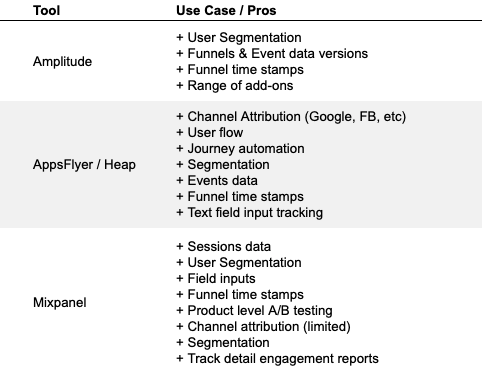
(1) Amplitude (2) Appsflyer (3) Heap (4) Mixpanel
Lastly, usage analytics is the best quantitative data source you will have. Regardless of what the other qualitative sources indicate, be sure to cross-check using these numbers.
If you’re building a consumer app, feel free to skip ahead since you likely don’t have a Sales team. If you’re building a B2B product, and have a sales team, leverage them to get customer insights.
This should not be mistaken for “Build what the sales team wants” because that can quickly lead to building for hyper-specific use cases and clutter your product. Rather, treat this as another source for qualitative data.
At Pathao, we’ve received a lot of feedback from drivers via our Operations teams over the years. Some employees in being ardent advocates for the drivers, have acted as voices of the customer on their behalf. They’ve helped us push a handful of UX features on the Driver app over the years.
Whenever you can, find and utilize these internal champions instead of letting their feedback fall on deaf ears.
Focus groups, when correctly assembled, are a useful tool to capture customer insights.
Bear in mind this stuff is qualitative data and is likely to be directionally correct rather than specifically accurate. In the early days of Pathao, we did a lot of focus group discussions and learned a few things from our early users and drivers.
For example, the fact that our waiting screen did not have any indication of progress left users feeling uncertain about whether their request was placed and being assigned. These were early days for ride-sharing in Bangladesh and these simple UX cues went a long way in getting users comfortable ordering.
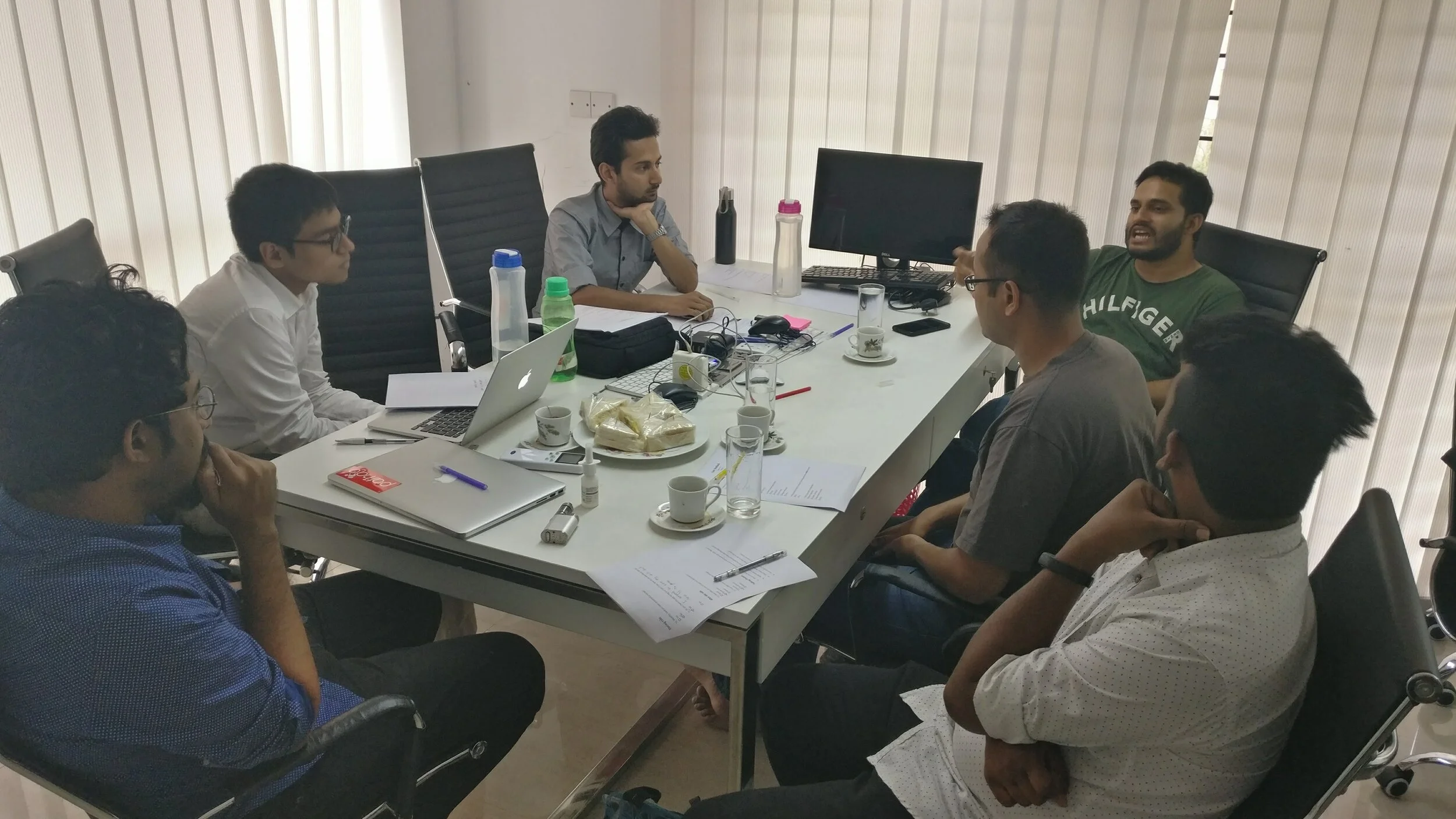
Customer interviews circa 2017
Customer support can provide good data points to understand customer pain points.
For instance, take a look at the most frequent support tickets. You’ll find a bunch of broken UX issues or feature candidates that, if shipped, can help customers instantly.
For us, the most recent example was updating carts. Whenever an item is unavailable or a restaurant closed, the deliverymen had to call Customer Support to update or cancel the order. On the other hand, customers usually wanted to alter their orders and take something else instead. This back and forth was previously mediated by Support agents and consisted of a large chunk of their tickets.
What if drivers and users could sort this out themselves? I’m glad you asked…
Does your company intend to stick to what it’s doing now and get 10x better at it?
Or are there plans to expand into adjacent industries/geographies/use-cases?
These strategic questions should inform how you should shape your product, brand, and indeed the tech stack.
While it’s usually advised to be customer-obsessed, it helps to be informed of what your competitors are doing to benchmark how better/worse off your startup is performing.
In fact, it can help you understand several interesting things, such as:
Are customers defecting to a competitor for a specific feature (technical or quality-related) that you don’t cater to yet?
Are there specific geographies your competitors are out-performing you?
In summary, to me, being “data-driven” means being in an effective feedback loop between all of these data sources and then making short, medium, and eventually long-term product/company bets.
(SUCCESSFUL) CAREER = SKILLS + OPPORTUNITIES
Don't have a rigid "career plan" – The world is changing too rapidly and life is too complex for anyone to accurately predict the future. Be flexible.
Develop skills that are rare & valuable.
Be on the lookout for opportunities with the best risk-reward ratios.
OPPORTUNITIES - THERE ARE TWO KINDS.
The first will present itself to you (ex: your friends are starting an exciting company and want you to join)
The latter you may go out and create. (ex: Last year, someone working at McKinsey in the UK reached to me via Linkedin for a Product role at Pathao because they wanted an experience in frontier markets)
Either way, the ability to properly assess opportunities based on risk-reward is vitally important.
SKILLS - THERE ARE TWO KINDS.
Be Michael Phelps - Top 1% of their field. Gifted with the right physique and fanatically driven to train and reach the zenith of their field.
Be Shakib Al Hasan - Top 25% in multiple skills/fields. In 2021, if you're an 80th percentile programmer + communicator + designer, you're extremely well-placed for financial success. This is because this combination is both rare and valuable. This brings us to...
Capitalism rewards people with skills (or a combination of skills) that are both rare and valuable.
WHAT SKILLS (OR COMBINATION OF SKILLS) ARE RARE & VALUABLE?
In my opinion, these 5 skills (or a mix of them) are quite valuable. In terms of hard skills (or educational ones) – anything technical is a great choice. More on this later.
Communication: Communicating skilfully means conveying information so that it changes people’s behavior… or at least probes their thinking. Most technical people quaintly underestimate this skill. They expect good ideas to prevail based on merit. Good ideas are not Immiscible like oil. They don't necessarily surface because of their innate quality. Ideas are like precious metals. They need to be dug out, polished and marketed to have economic value.
Leadership: Learn how to lead people. Whether it’s through a university club (ex: NSU YEF / IBA CC) or practical work experience (ex: from a good manager at your job). Even if you choose to be an individual contributor, knowing how to lead/manage a team makes you less reliant on others for organizing things.
Sales: Selling doesn’t mean talking someone into buying things they don’t need. It means finding common ground with people and showing them your point of view.
Finance: Being financially literate is a huge advantage. The good news is that there are very easy wins. Get better at personal finance. (ex: know how your taxes are calculated). Learn how to read financial statements (ex: Balance sheets, income statements) Finally, learn more about how capital markets work, internationally. That last bit is important (and overlooked), which brings us to…
Global: The world is vast. It is teeming with people, capital, and opportunities. But you’ll never come across it if you’re stuck in your 9-5 and Dhaka traffic. The internet is your oyster, explore it. Meet people. Travel. Open your mind.
I will dissect opportunities in a future post.
If you liked this, feel free to subscribe to Build Bangla: https://www.ahmedfahad.com/buildbangla
This was first published on the Financial Express.
In the past decade, Bangladesh has seen salient improvements in health care. We’ve significantly reduced child mortality rate and maternal death, and increased immunization coverage and life expectancy of citizens.
That said, there is a huge disparity in health care distribution between urban and rural areas, a large portion of people living in rural areas are deprived of modern health care facilities. The total population in Bangladesh is over 160 million (World Bank, 2018). Among them, 77% people live in rural areas. Access to medical personnel (general practitioners), medical facilities, and equipment is unevenly distributed throughout the country.
Two problems stand out:
Most doctors in Bangladesh are located in urban areas due to poor infrastructure in rural health care centers and villages.
Rural dwellers are required to travel long distances to access health care services which makes it costly and time-consuming. Cost is two-fold. There is a cost of travel and a cost of treatment.
Telemedicine in Bangladesh
Telemedicine service takes advantage of the developments in telecommunication and growing internet facilities to provide medical facilities in remote areas where modern health facilities are limited.
The idea isn’t new. In fact, telemedicine in Bangladesh emerged around 1999 when a telemedicine link was established by a charitable trust named Swinfen Charitable. Although it was a short-lived collaboration it planted the seed of an idea for remote treatment quite early. Over the years, many attempts at telemedicine have been taken.
In 2005, Grameen Telecom (GTC) in cooperation with the Diabetic Association of Bangladesh (DAB) launched telemedicine services, giving patients at Faridpur General Hospital access to specialist doctors of their choice in Dhaka. DAB’s BIRDEM Hospital Dhaka, was connected via a video conferencing link to DAB’s Faridpur General Hospital.
What does the post mortem of these initiatives reveal?
The initial results of the DAB Pilot Project were promising. In the first 3 months, there were 52 new patients and 6 returning patients. However, it never took off. The number of patients waned over the months. They had technical problems which made service delivery difficult. Another reason for failure is implementing the project in a city that’s quite near to Dhaka. It takes only 1.5-2 hours to travel between Dhaka and Faridpur by bus. Thus, the problem of access to physicians in the city may not have been as acute for Faridpur residents.
Mostafa et.al in a study stated as ‘Even though enthusiasm has been observed in deploying telemedicine in Bangladesh from different quarters, however, lack of sustainability and long-term deployments are major issues. Many pilot projects are not followed up to turn into stable and fully functional healthcare systems. The primary reason is that the projects started with a narrow scope and did not address a proper framework for telemedicine application in Bangladesh.’
What does success look like for Telemedicine?
The success of Telemedicine largely depends on effective communication during consultation in spite of differences in location, time, equipment, levels of expertise, and health care organizations involved in the exchange.
Challenges
According to Shammi Quddus, previously at health startup Jeeon, “As of today, telemedicine is a product for urban folks. For rural people the user experience is poor so that people don't come back. Also what you can solve is very limited. One can only prescribe OTC drugs, the video actually does not add any additional treatment abilities. In that way Grameen’s 789 is probably the most cost-efficient way to deliver the same outcome.
Where telemedicine adds huge value is for pre-existing doctor-patient relationships. Follow-up reports, regular check-in so that you are saving the time and cost of Dhaka traffic, getting your tests done and results back, and the doctor then actually has something valuable to opine on.”
Ahmed Bakr, from the current Jeeon team mentioned “With enough information, our doctors prescribed more than OTCs where necessary, especially in the dermatology cases. The key piece being: enough information such as pictures of past tests, reports, and prescriptions as well as current weight, BP, temp, etc. Getting all that information is challenging and time consuming”
What has changed in the past 5 years?
Mobile Phone Connections: As of March 2020 there are 165 million mobile connections in Bangladesh (BRTC, 2020). Compared to population numbers, that’s nearly 100% penetration. Of course, this is not true since the number doesn’t represent unique mobile connections. It is, however, directionally correct to say that nearly everybody now has access to a mobile phone.
Internet Usage: There are 103 million internet subscribers, out of which 95 million are using mobile internet. That means more than 57% of mobile users are using mobile data. This number is likely higher since not all mobile connections are active or unique, thus the denominator is likely smaller. The number of internet users is growing at a healthy rate of 10% yearly.
Bangladesh has become mobile-first: More than 62% of web traffic is coming from mobile devices, roughly 32% from desktops, laptops, etc.
Android hails supreme: More than 95% of mobile traffic comes from Android devices. Less than 2% from iOS.
These trends will likely continue for the next 5 years as local manufacturing of smartphones continues to drive down prices, mobile data gets cheaper and digital literacy continues to grow.
All of this is to say, internet services delivered via android smartphones are the best way to reach the average Bangladeshi today. This holds true in the context of telemedicine.
Who are players in this space?
Here’s a comparison of startups in the health-tech space, as of May 2020:
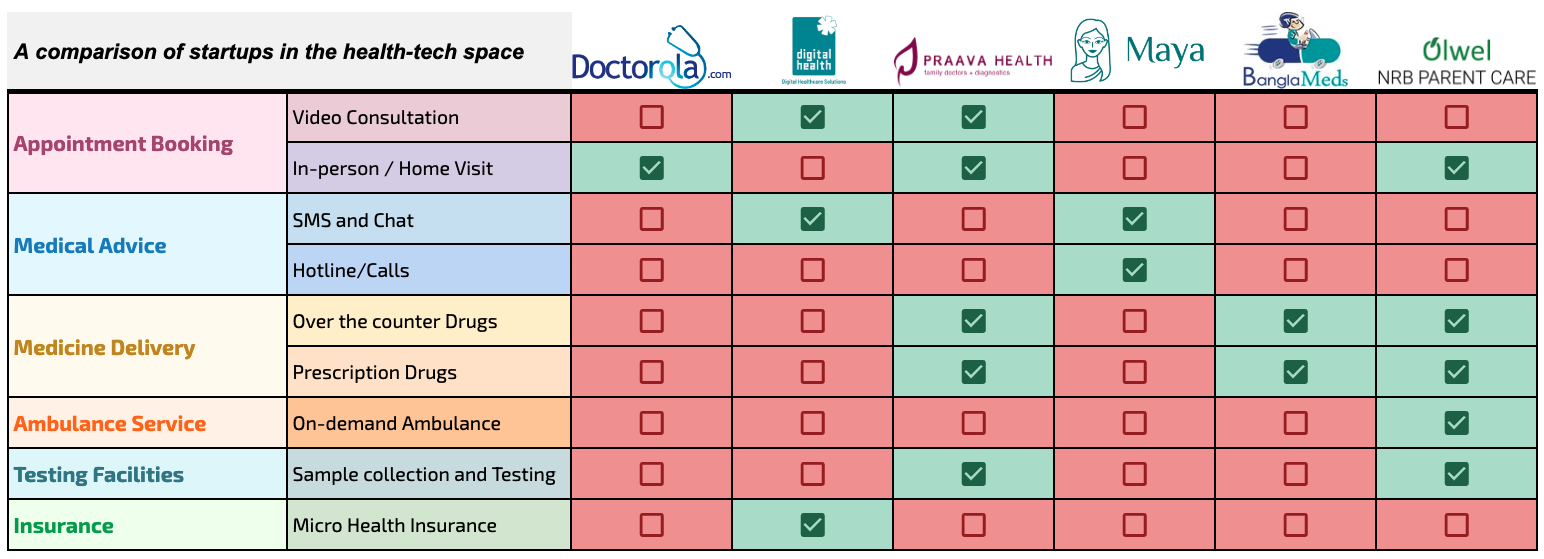
Download here (Could also make this the cover image)
These organizations have done well in developing a network of general practitioners and establishing reliable operations. Through increasing awareness about telemedicine and delivering reliable service each startup has received good traction. Although they carved out a niche for their services, their distribution and reach is limited.
There may be an opportunity to increase the awareness and adoption of these telemedicine and related services by featuring them in more widely distributed internet-enabled services.
Three options come to mind:
Grameenphone is in a prime position to do this with their MyGP app. With over 40 million downloads, it has extensive reach and is more geographically dispersed than other apps.
They have the customer information, the payments system in place and the balance sheet to take on this line of business.
Providing these value-added services shouldn't be an antitrust issue either. After all, the MyGP app already houses 3rd party services.
Having the vision and driving the execution may be a challenge. The bureaucracy is particularly virulent in large companies such as GP, with employees buried under 8 or more layers of management.
They have the reach. They are already pushing for adoption of the app, which has crossed 10million downloads. They have also been onboarding 3rd party services onto the platform. This could be a good use case for them.
Their interface and experience is not optimized for these use cases yet, but it's not a daunting task for the team there.
With over 6 million downloads and a network of users and drivers across the country – the Pathao app could also play this role of the aggregator.
In fact, last week Pathao launched Pathao Health, in collaboration with some leading health-tech startups. They aim to serve 1 million users in the next 90 days.
Telemedicine can level regional differences since the same information can be accessed sitting at home as from a medical facility several thousand kilometers away.
In terms of cost, studies revealed that telemedicine service reduces the health care cost of patients to a great extent. Users had to spend even less than 1/10th the amount to access the same service in a conventional means of the service. This is possible through higher efficiency (doctors being able to serve more patients) and lower infrastructure costs.
It’s unlikely that telemedicine can replace physical clinics. Instead, the aim should be to harness technology and empower doctors to fulfill their calling of helping patients, bringing down the geographic and cost barriers many folds.
Security considerations are a major obstacle to telemedicine uptake. These include an absence of a legal framework to allow health professionals to deliver services in different parts of a country; a lack of policies that govern patient privacy and confidentiality vis-à-vis data transfer, storage, and sharing between health professionals and corporations; medical liability for the health professionals offering telemedicine services, health professional authentication and so on.
This was first published on the Financial Express.
Full disclosure: I work at Pathao, which gives me a good insight into the race for use cases among aggregators/platforms. I’ve tried my best to be objective throughout this analysis.
––––––––––––––––––––––––––––––––––
Ahmed Fahad is VP & Head of Product at Pathao, and a Global Shaper of the World Economic Forum. He can be reached at fahad@pathao.com
This article also appeared on Future Startup.
Lessons on
Moving Fast
–
100X Growth
in 7 days
Khobaib bhai, having followed the fast launch and growth of Tong – asked me this question.
As always, bhaia has put forth a well-phrased question.
A couple of thoughts before answering:
0-100 customers are about finding product/market fit and (dis)proving assumptions about your business model.
There is no one-size-fits-all.
But there are guiding principles that hold true at different stages.
The COVID-19 lockdown has created an acute need for grocery delivery– the demand curve, for sure, would have looked different at any other time.
Here’s what Tong’s growth looked like in the first 8 days:
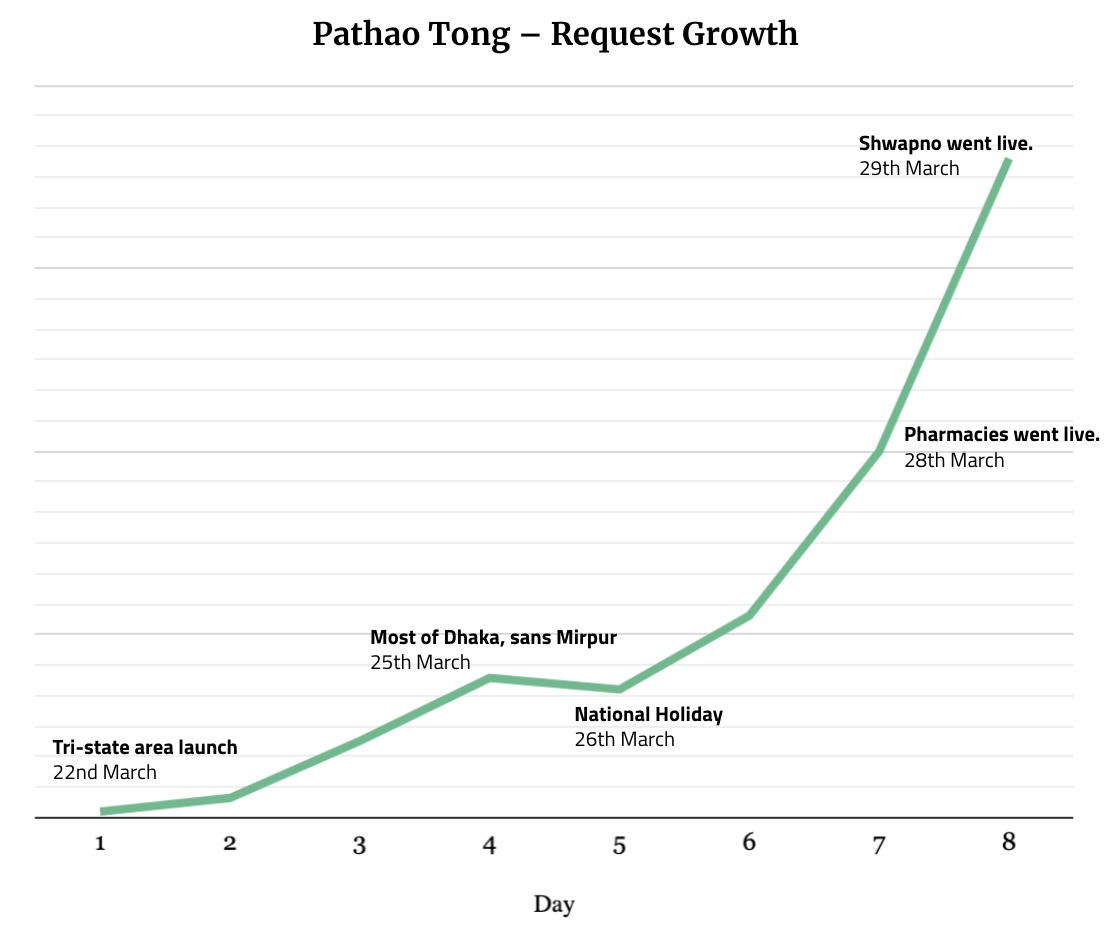
In terms of principles, I would say 3 things:
Let’s dive in.
On Day 0,
Your only job as Founder/Launcher is to state your assumptions and run experiments to see whether they hold true in the real world.
You could do market surveys, desk research, customer interviews, quantitative modeling. Or – you could quickly create an MVP. Release it. Learn from the market.
By now, you know which one we preferred.
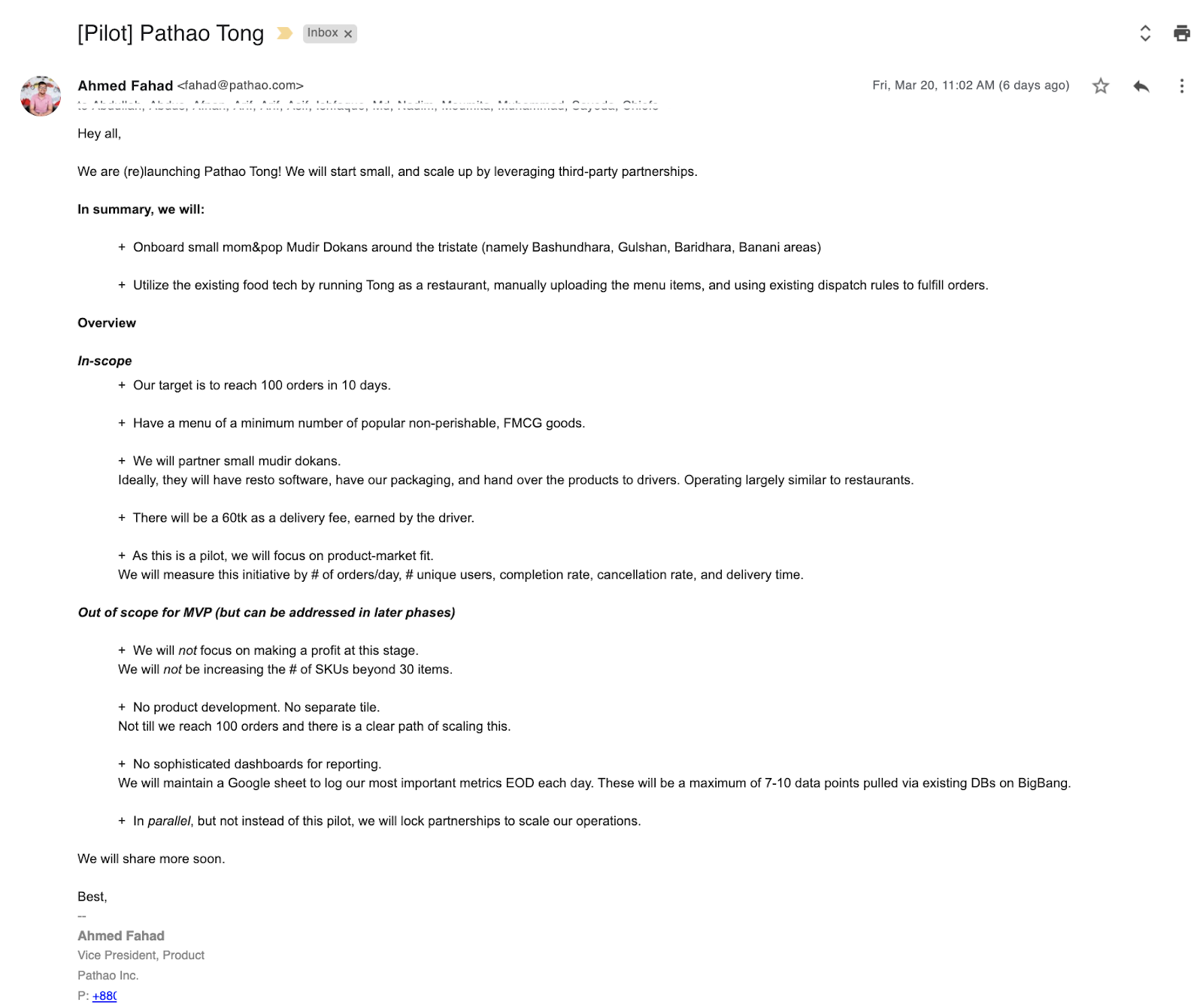
Here’s the email I sent our team before starting work on Tong.
This initial game plan, executed well by the team, got us the first 100 orders.
Based on our data from Pathao Food, we know the Banani-Gulshan-Bashundhara area is a hotbed for online orders and compared to other areas in South Dhaka these places had a scarcity of convenience stores around them.
Thus, this ‘Tristate area’ was perfect to start our first Tong.
By onboarding a superstore near Banani Bazaar, we could cover Banani and Gulshan-2. That too, without screwing up our targeted delivery time of 30 mins.
That left Bashundhara, which we’d need 1-2 stores to cover.
So 2-3 stores to start. Let’s do this.
Four of us were at Banani Super Market. We convinced the owner of the store to be on Tong – for them, it’s simply more sales.
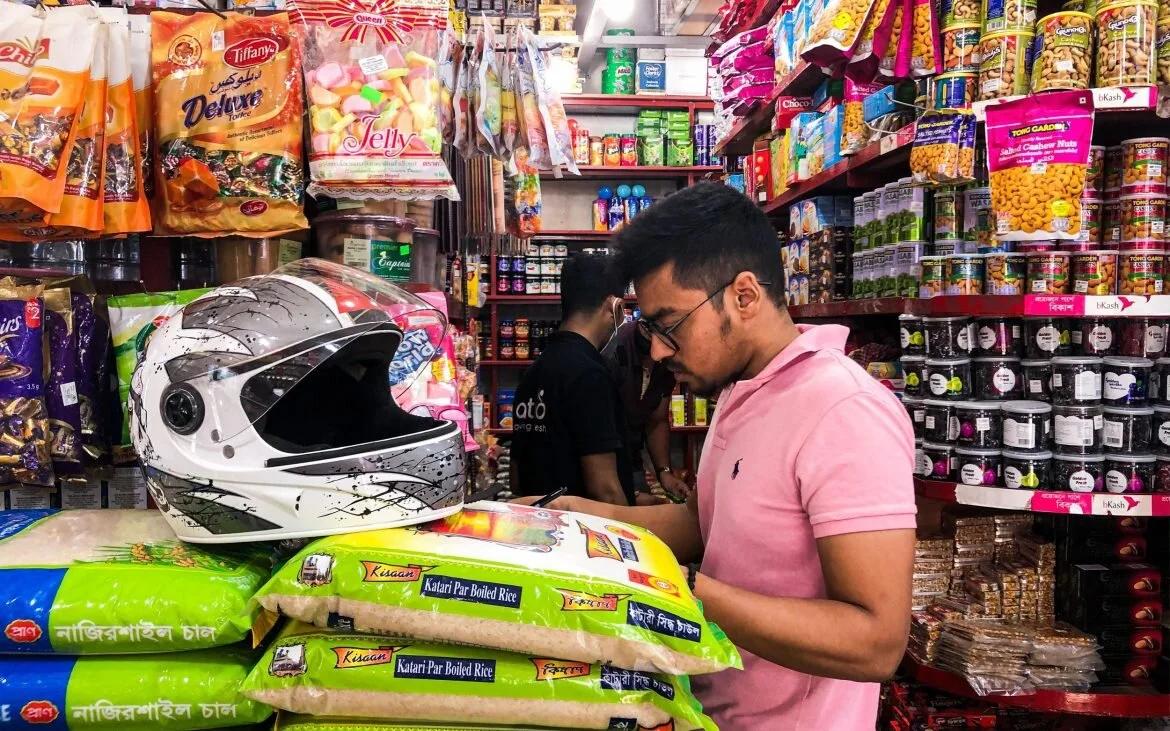
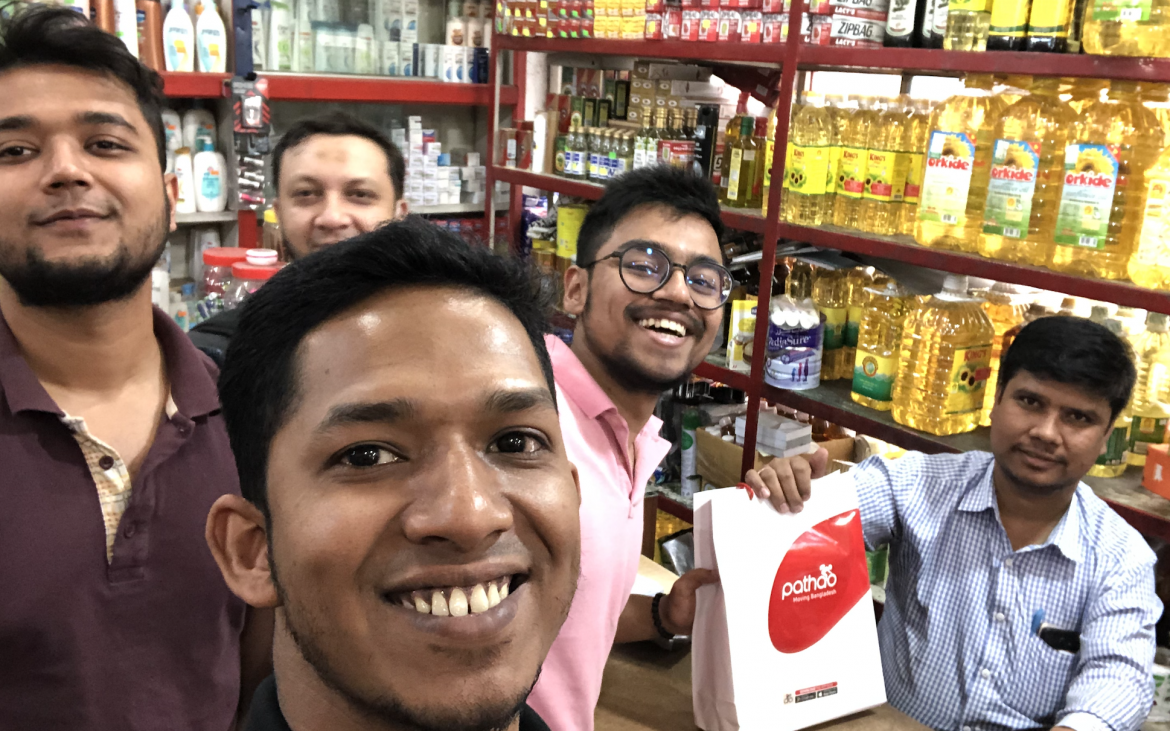
For our first 2-3 Mudir Dokans, we went with pen & paper to note their inventory. We had to chase the store clerks for prices and availability.
That said, we were clear on two things:
We would start with no more than 30 essential products
These products should always be in stock
This would be enough for our MVP.
You too should narrow your focus and decide what’s the bare minimum needed for your MVP. Guard your team’s precious energy and time.
Anyway, back to the story.
And after 2 hours of note taking, speaking to the staff and placing our banners at the store – we left excited...but also wondering if we exposed ourselves to COVID-19 in that crowded store.
That same night, we sat down and transcribed the inventory lists.
35 items, at each of the 3 locations.
Another 4 hours.
In parallel, operations started educating drivers about what they needed to do. Outbound calls and notifications were underway.
In parallel, designers got our design work done.
In parallel, marketing got user side communications ready.
The Founders/launchers are basically jugglers.
Her job is to keep several things in the air simultaneously
Not holding any item herself but making sure they’re all moving and the act is coming together.
Post on social media. Get the word out. Rally your friends up to launch.
It helps to have a precise launch time.
Everyone works towards that deadline.
12pm is nice because it’s before lunchtime.
It’s out in the wild now.
At times requests will spike and you won’t be able to keep up, other times it will feel like your mom’s the only person ordering to show support.
Either way, it’s data.
Read it, discuss it with your team, collectively (but decisively) take action.
I’ve heard people (and myself) ask before
Monitor traction.
How’s the traffic on your app/site? How are orders? How are they compared to your expectations? More on this on another post.
Talk to your customers.
In our case – we talked to customers, and even more rigorously to our delivery people. What do you think? What’s easy, what’s hard?If you’ve found a product/market fit, you’ll know it.
If you have to ask, then you probably don’t, yet.
100s of requests are cool. But you know what’s cooler? 10x that.
But, your old model breaks apart at 10x.
Let’s try asking our first model a few questions…
Why do we put in the time to go physically ‘onboard’ Mudir Dokans?
Don’t all of them have (almost) the same products?
Ok, and if all Mudir Dokans are the same, why do drivers need to go to a specific one? Why not go to their nearest one and be done with?
Could we also deliver medicine? Maybe just non-prescriptive ones to start?
I think you and I arrived at the same answers.
It was time to virtually onboard dokans all over Dhaka.
–––––––––
Operationally,
How would we balance supply (or delivery people) to meet demand?
How do we raise awareness and market this quickly?
As a business,
What’s the revenue model? How will this fit into our business in the medium-long run?
What synergies and comparative advantages are there?
In the final article, I will cover:
The challenges we faced in scaling distribution in the midst of a lockdown.
Moving towards a longer-term, sustainable business.
Till then, keep growing.
👉 The final article will appear in my newsletter first – Build Bangla.
Build Bangla is a curated monthly roundup of my writing and stuff I’m following.
Shoutout to Khobaib bhai, Ruhul bhai, Tawsif bhai for reading versions of this.
This article was first published on 28th October 2019 on Future Startup
This month, we launched Pathao Points – a unique rewards program that lets our customers earn points every time they use Pathao for rides or food deliveries. Along the way, these points unlock exclusive and exciting benefits for our members.
What’s your reasoning for launching such a product (Pathao Points)? How does it work? What research went into it? How long did it take? Did we design for the long-term? What metrics do we look at?
These questions are not only relevant to Pathao points but also in any product development context – be it Pathao Points, Rides, Food – or any other tech product for this matter.
In this 3-part series, I plan to answer these questions using Pathao Points as an example but I hope the details will be useful for anyone working on developing technology products in Bangladesh and beyond.
Why build Pathao Points, at all?
As a homegrown startup, our community has been a big part of our journey.
We’ve always wanted to recognize and reward this community for choosing us. With this program, we’re excited to be taking a big step towards that.
Customer retention is a big focus area for us. We want to be the platform of choice for our users, consistently and are eager to work for it.
It is far more expensive to acquire a new user than to retain an existing one.
It only makes sense to put our efforts into building for the customers who are with us. Pathao Points is exactly that – a program to recognize and reward our users.
The points that our users earn give them access to a wide range of rewards and discounts that are designed to truly matter to them.
There are four membership levels: Bronze, Silver, Gold, Platinum, and users are enrolled automatically at no cost.
Once in the program, users will start earning one point for every taka spent on the Pathao platform. Once a user earns 200 points, they’ll advance from Bronze to Silver. At 1,000 points, users will be promoted to Gold tier. And at 7,000 points, users will be advanced to the highest tier, Platinum.
Since this project dealt with rewards and customer relationships, we thought trust and reliability were very important. The internal name for this project was ‘Sancus’ – named after the Greek god of trust and oaths.
Before diving in, I must emphasize our goal is to build things that work, not ship fast...although we do that well. Here’s how:
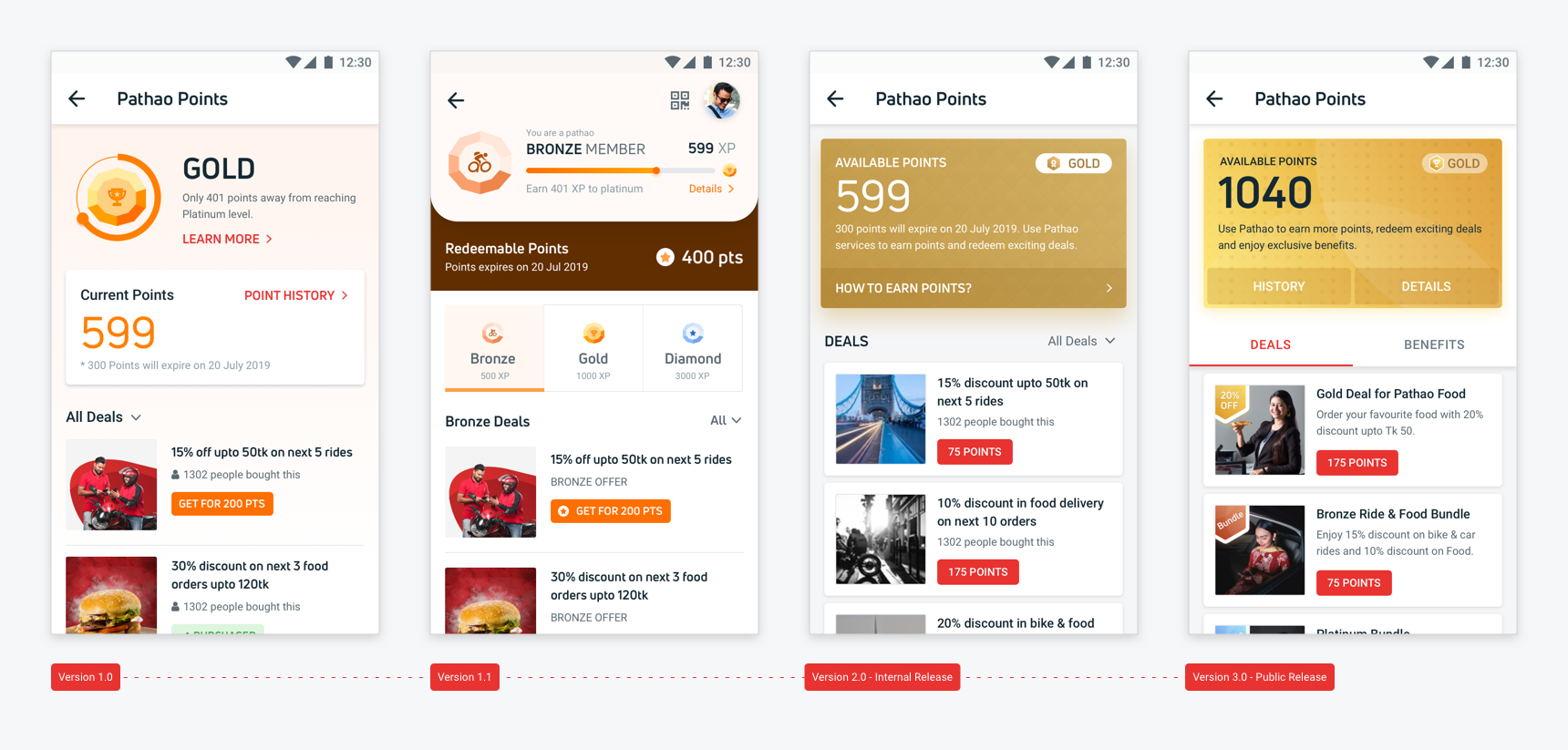
Fig: Explorations and refinements we’ve done before the MVP launch.
Upon release, we expected the first version of this product to go through many iterations based on feedback from the market.
To allow for fast turnarounds and push updates easily – building the frontend on the web, instead of native android/iOS made sense.
On one hand, frontend changes to Android/iOS platforms require full updates and are dependent on the user accepting the said update.
On the other hand, the web view approach loads the updated UI each time.
But there were concerns with a Web-View based approach.
We hadn’t used a web-view for any major part of the app experience before. Naturally, this was uncharted territory.
Would there be trade-offs in the experience? Would there be lag? Is there a possibility for it appearing inconsistent compared to the rest of the app? Would the frontend be able to handle the load?
We decided to experiment and created a POC (proof-of-concept). Our web frontend team built a few HTML/CSS pages. We hooked them up to the app then tested performance. The result was far better than we had hoped for.
It was not perfect, but it could be polished and iterated to create something amazing. There were a few usability issues, a few design considerations. A diamond in the rough, if you will.
After a few iterations, we were happy with the performance. No lag. No major usability issues. No bugs. We decided to go forward with the web-view solution.
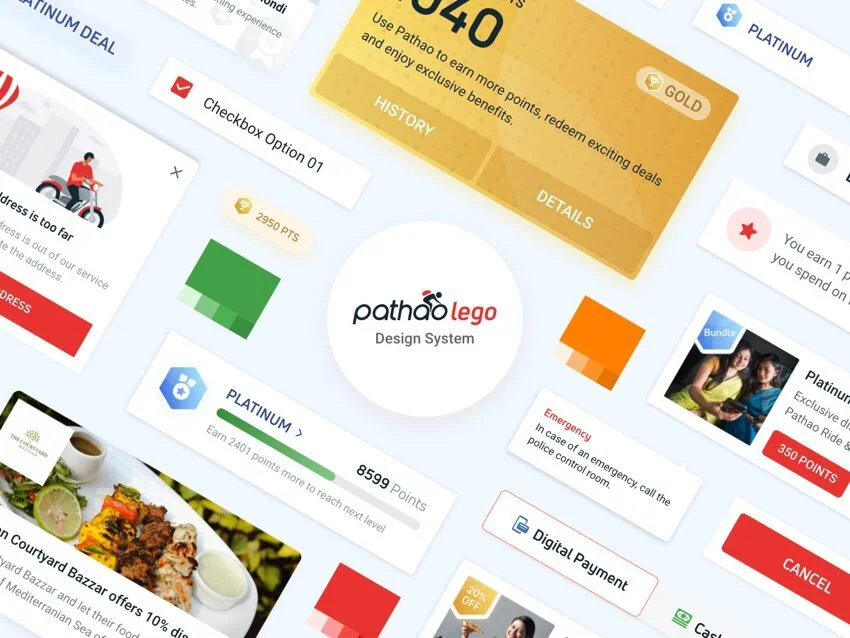
Earlier this year, we had spent time standardizing our design language and guidelines. We created our very own UI library, named Lego, with pluggable components that meet our needs.
This library is our source of truth. It acts as a boiler plate to start new projects. More importantly, Lego ensures consistency through our app, website and other touchpoints.
In a nutshell, Lego saves time while working on any UI and helps us build new user experiences at lightning speed.
Using patterns and learnings from building similar robust systems like our Payments service, from back in the day, our engineering team decided to go with a microservice-based architecture. On a high-level, there would be four main services.
POCKETS – Would handle all things Points.
SQUARE – Responsible for all things Deals.
NIGHTWING– Admin tool to manage deals.
QUICKSILVER- Responsible for rendering the web-views.
There would need to be a few other microservices supporting this stuff but, by and large, these four would be the pillars on top of which we’d build this system.
Traditionally, measuring the impact of product releases has been an afterthought. This leaves no one better off. We now plan for it even before writing a line of code.
It’s difficult to reliably know how vital a feature or variable is unless we can deploy it in both - a control and treatment environment and measure the effects.
Sure, qualitative ways of interviewing users could be used – but there are issues. At the scale Pathao operates, FGDs and interviews are rarely representative. Especially for a product that runs on the entire platform. Thus, quantitative methods, A/B testing is our way to go.
Easier said than done, of course.
It requires development, setup, and know-how to run a proper experiment and A/B test. This is rare expertise to come by, without experience.
Most of the questions we have about Sancus (internal name) – the stuff we want to test and iterate on, have an A/B testing mechanism built-in.
That means we are able to have control-treatment groups, rollout specific features to cohort user groups and much more.
We then monitor the data for the two groups, analyze the data to derive insights, and take appropriate actions.
As Peter Drucker rightly said,
“What gets measured gets managed”
We’ve found face-to-face communication to be essential. But we don’t want to bury builders with meetings. On the other hand, email and text messages are sometimes slow ways to coordinate. We needed to strike a balance.
Our Capstone Project Management Tracker – Maintained by the Product and Engineering leads, it gives a birds eye view of our progress and priorities.
Standups and Face2Face Meetings – We had stand-ups, with the 6/7 core team members roughly twice a week. Usually on Mondays and Thursdays. This cadence allowed us to unblock issues and keep track of progress – while also spending minimum time on such meetings.
We’ve found face-to-face communication to be essential. But then, we don’t want to bury builders with meetings. On the other hand, email and text messages are sometimes slow ways to coordinate. We needed to strike a balance.
During retrospectives, we purposefully spend more time on the negatives. Nothing, NOTHING is off the table for discussion, but EVERYTHING must result in an action.
Document the things that matter:
Early-on I started collecting meeting minutes for all the different meetings I was having with tech, the marketplace, marketing, partnerships, and such teams. At the end of each meeting, I sent out a recap and the next steps to be taken. This discipline didn’t last throughout, but it was there long enough to get us off the ground.
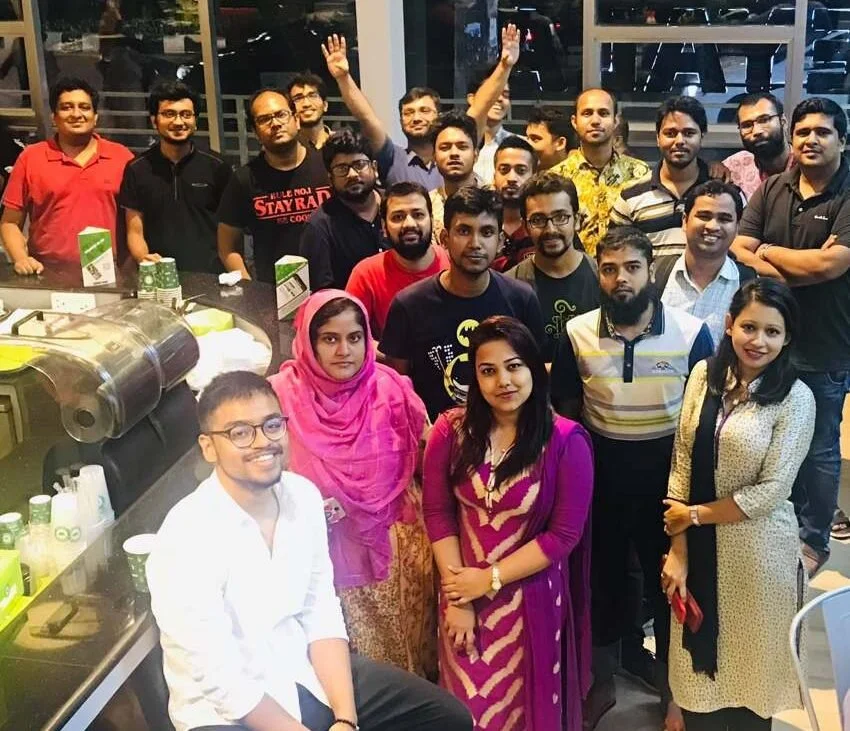
It goes without saying, there are folks who’ve contributed but aren’t in the frame, to whom we’re grateful. Among them, I’d mention Jitu bhai for his contributions in the early stages of this product.